
Accessories
Triband vs Quadband 2G, 3G, 4G LTE & 5G Signal Boosters in Kenya
May
Comparing Triband and Quadband 2G, 3G, 4G LTE & 5G Signal Boosters in Kenya
Choosing between a triband and quadband signal booster is one of the most common challenges for people trying to improve weak Safaricom, Airtel, Telkom Kenya, or Faiba JTL network coverage indoors.
Both systems are designed to improve mobile signal reception, reduce dropped calls, and enhance internet speeds, but they differ in supported frequency bands, coverage capability, installation flexibility, and ideal use cases.
If you are still researching how mobile signal boosters work, we recommend first reading our complete buying guide for signal boosters in Kenya .
You can also read our guide on the best signal boosters for Safaricom, Airtel, Telkom & Faiba JTL networks to understand which systems work best for different mobile providers in Kenya.
How Mobile Signal Boosters Work
A mobile signal booster captures weak outdoor signal using an external antenna, amplifies it through the booster unit, and redistributes stronger signal indoors using one or more indoor antennas.
The overall performance depends on:
- Outdoor signal strength
- Building structure
- Booster power and supported bands
- Antenna positioning
- Cable quality and installation
The main difference between triband and quadband systems is the number of frequency bands supported and the type of coverage environment they are designed for.
Understanding Triband Signal Boosters
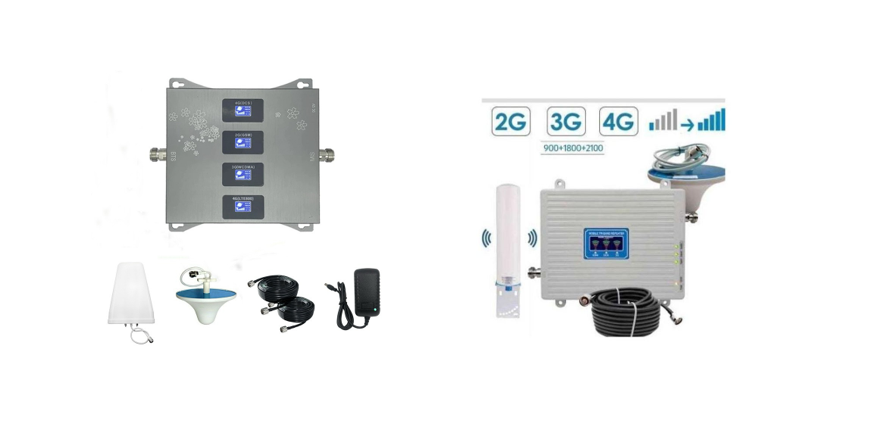
A triband signal booster supports three major mobile frequency bands commonly used for 2G, 3G, and 4G communication in Kenya.
Triband signal boosters are commonly used in:
- Homes and apartments
- Small offices
- Retail shops
- Small business premises
- Standard indoor coverage improvement
These systems are generally easier to install and are suitable for smaller to medium indoor coverage requirements.
Understanding Quadband Signal Boosters
A quadband signal booster supports four mobile frequency bands, allowing broader compatibility across 2G, 3G, 4G LTE, and some 5G-ready frequencies used by Kenyan mobile networks.
Quadband signal boosters are better suited for:
- Larger homes
- Commercial offices
- Warehouses
- Hotels and hospitals
- Large buildings
- Areas with many users
- Installations requiring multiple indoor antennas
Quadband systems usually provide stronger 4G LTE support and more flexible coverage expansion for larger installations.
Triband vs Quadband Signal Booster Comparison
| Feature | Triband Booster | Quadband Booster |
|---|---|---|
| Supported Signals | 2G, 3G & 4G | 2G, 3G, 4G LTE & 5G-ready |
| Best For | Homes, apartments, shops and small offices | Commercial buildings and larger installations |
| Coverage Capability | Small to Medium Areas | Medium to Large Areas |
| Network Compatibility | Safaricom, Airtel & Telkom | Safaricom, Airtel, Telkom & Faiba JTL |
| Internet Performance | Good for standard usage | Better for heavy 4G LTE usage and multiple users |
| Installation Complexity | Simple | Moderate to Advanced |
| Typical Cost | Lower price range | Higher price range |
Recommended Signal Booster by Building Type
| Site Type | Common Problem | Recommended Booster |
|---|---|---|
| Homes & Apartments | Weak indoor signal, dropped calls | Triband/Quadband signal booster |
| Offices & Shops | Poor voice calls and slow internet | Triband or Quadband signal booster |
| Warehouses & Large Buildings | Wide coverage gaps | Quadband booster/High Power Boosters with splitters and multiple antennas |
| Hotels, Hospitals & Institutions | Multi-room and multi-floor dead zones | Quadband booster/High Power Boosters with splitters and multiple antennas |
| Basements & Parking Areas | No indoor mobile reception | Quadband booster/High Power Boosters with splitters and multiple antennas |
Accessories That Improve Signal Coverage
A properly designed signal booster system may require additional accessories depending on building size, room layout, and coverage requirements.
- Outdoor Omni Antenna for capturing stronger outdoor signal
- Indoor Omni Antenna for distributing signal indoors
- 4-Way GSM Splitter for multi-room or multi-floor coverage
- Signal Booster Connectors for reliable cable connections
Professional Installation for Larger Buildings
Small home installations may work with DIY setups, but warehouses, office buildings, hotels, hospitals, schools, and multi-floor installations usually require professional planning and installation.
Rapidtech Networks Limited provides professional signal booster installation services in Kenya , including site surveys, BOQ preparation, cable routing, installation, and signal optimization.
Estimated Price Ranges for Triband and Quadband Systems
| Booster Type | Typical Use Case | Estimated Price Range |
|---|---|---|
| Triband Booster | Homes, apartments, shops and small offices | KSh 13,000 – KSh 25,000 |
| Quadband Booster | Homes, offices and medium buildings | KSh 25,000 – KSh 60,000 |
| High Power Quadband System | Warehouses, hotels and commercial projects | KSh 60,000 – KSh 150,000+ |
Choosing the Right Signal Booster for Your Needs
If your goal is improving indoor mobile coverage in a home, apartment, shop, or small office, a triband or quadband booster may be sufficient depending on the size of the area and network requirements.
For warehouses, commercial buildings, institutions, hotels, hospitals, and large installations, high-power quadband systems with splitters and multiple antennas are usually the best long-term solution.
Browse our collection of 2G, 3G, 4G LTE & 5G signal boosters in Kenya or contact Rapidtech Networks Limited for help selecting the right system for your building.

Pingback: How to Install a 2G, 3G, 4G LTE & 5G Signal Booster in Kenya | Rapidtech Networks Limited
Pingback: Best Places to Install a 2G, 3G, 4G LTE & 5G Signal Booster in Kenya | Rapidtech Networks Limited
Pingback: Signal Booster Prices in Kenya (2026 Guide) | Rapidtech Networks Limited
Pingback: Signal Booster Installation Cost in Kenya | Rapidtech Networks Limited