
Networking
Active Cladding Alignment vs Core Alignment vs Cladding Alignment Fusion Splicers: Complete Comparison Guide
Jun
When evaluating a fiber fusion splicer, one of the most important specifications is the alignment technology used by the machine. Alignment technology directly affects splice loss, installation quality, project suitability, equipment cost, and long-term network performance. While many buyers focus on battery capacity, splicing speed, or display size, alignment technology often has the greatest impact on actual splice quality.
Modern fusion splicers generally fall into three categories: Core Alignment, Active Cladding Alignment, and Cladding Alignment. Each approach has advantages and limitations depending on the project requirements. Understanding the differences helps technicians, contractors, ISPs, and telecom operators select equipment that matches their deployment needs.
This guide follows our previous article on Fusion Splicer Motor Count Explained: 2 Motor vs 4 Motor vs 6 Motor Machines. You can also browse our complete range of Fiber Optic Splicing Machines.
What Is Fiber Alignment in Fusion Splicing?
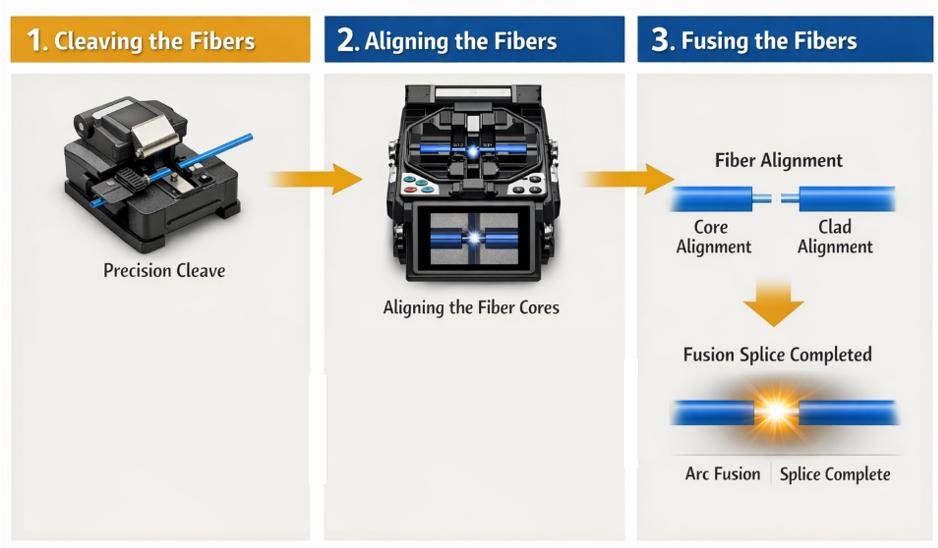
Before two fibers can be fused together, they must be aligned accurately. The purpose of alignment is to ensure that light passing through one fiber continues into the second fiber with minimal loss. The more accurately the fibers are aligned, the lower the splice loss and the better the network performance.
Different fusion splicer technologies use different methods to achieve alignment. Some align the actual fiber cores, while others align the outer cladding surfaces. More advanced systems use moving motors and image processing to improve accuracy.
Alignment Technology Comparison
| Feature | Core Alignment | Active Cladding Alignment | Cladding Alignment |
|---|---|---|---|
| Alignment Method | Fiber core | Moving cladding alignment | Fixed cladding alignment |
| Motor Count | 6 Motors | 4 Motors | 2 Motors |
| Typical Splice Loss | ~0.02dB | 0.03–0.05dB | 0.03–0.08dB |
| FTTH Suitability | Excellent | Excellent | Good |
| ISP Networks | Excellent | Good | Limited |
| Telecom Backbone | Recommended | Limited | Not Recommended |
| Equipment Cost | Highest | Moderate | Lowest |
What Is Core Alignment?
Core alignment fusion splicers use cameras and image processing systems to identify the actual fiber cores and align them precisely before fusion. Because optical signals travel through the core, aligning the cores directly produces lower splice loss and more consistent results.
Core alignment systems are commonly used for:
- ISP deployment
- Telecom backbone networks
- Enterprise fiber infrastructure
- Long-distance fiber routes
- High-performance optical networks
Examples include professional models such as the Signal Fire AI-9.
Advantages of Core Alignment
- Lowest splice loss
- Improved network performance
- Better handling of challenging fiber types
- Superior long-term reliability
- Preferred for telecom deployment
Disadvantages of Core Alignment
- Higher purchase cost
- More advanced technology
- May be unnecessary for simple projects
What Is Active Cladding Alignment?
Active cladding alignment uses movable motors to dynamically position the fiber cladding during the alignment process. While it does not directly align the core, it provides significantly better accuracy than traditional fixed cladding systems.
Active cladding alignment is particularly popular in:
- FTTH deployment
- Last-mile fiber installation
- Field maintenance
- Contractor projects
These systems offer a strong balance between cost and performance, making them attractive for contractors who require reliable field equipment without moving into telecom-grade pricing.
Advantages of Active Cladding Alignment
- Good splice quality
- Lower cost than core alignment
- Suitable for FTTH deployment
- Portable field operation
- Strong value proposition
Disadvantages of Active Cladding Alignment
- Slightly higher splice loss
- Not ideal for backbone deployment
- Less precise than core alignment
What Is Cladding Alignment?
Traditional cladding alignment systems position fibers using fixed V-grooves and align the outer cladding surfaces. These systems are generally simpler and less expensive than active cladding or core alignment machines.
They remain useful for:
- Budget-conscious deployments
- LAN installations
- Training environments
- Light-duty fiber work
Advantages of Cladding Alignment
- Affordable purchase cost
- Simple operation
- Suitable for basic projects
- Lower maintenance complexity
Disadvantages of Cladding Alignment
- Higher splice loss
- Reduced precision
- Limited telecom suitability
- Less flexibility with difficult fibers
Recommended Alignment Technology by Project Type
| Project Type | Recommended Alignment |
|---|---|
| FTTH Installations | Active Cladding or Core Alignment |
| ISP Networks | Core Alignment |
| Telecom Backbone | Core Alignment |
| Enterprise Fiber Networks | Core Alignment |
| Field Maintenance | Active Cladding Alignment |
| Budget Projects | Cladding Alignment |
Which Alignment Technology Should You Choose?
The answer depends on your project requirements. For telecom operators and ISPs, core alignment remains the preferred option because it delivers the lowest splice loss and highest consistency. For FTTH installers and contractors, active cladding alignment often provides the best balance between performance and affordability. For light-duty projects with strict budget constraints, traditional cladding alignment may still be sufficient.
Frequently Asked Questions
Which alignment technology produces the lowest splice loss?
Core alignment generally produces the lowest splice loss because it aligns the actual fiber cores before fusion.
Is active cladding alignment good for FTTH?
Yes. Active cladding alignment provides excellent performance for FTTH deployment and last-mile fiber projects.
Do ISPs use cladding alignment splicers?
Most ISPs prefer core alignment systems because they offer better consistency and lower attenuation.
Is core alignment worth the extra cost?
For contractors, ISPs, and telecom operators handling frequent deployments, the additional precision often justifies the investment.
Conclusion
Core alignment, active cladding alignment, and cladding alignment fusion splicers each have specific applications. Choosing the right technology depends on budget, project requirements, and performance expectations. Understanding these differences allows buyers to make better purchasing decisions and build more reliable fiber networks.

Pingback: Best Fusion Splicing Machines for FTTH, ISP and Telecom Networks | Rapidtech Networks Limited