
Networking
FTTH Installation Equipment Checklist
Jun
Successful FTTH (Fiber to the Home) installations require more than just a fusion splicer and fiber cable. Professional deployments depend on having the correct tools, testing equipment, consumables, safety gear, and accessories available before work begins. Missing a critical tool can delay installations, increase troubleshooting time, and reduce overall project efficiency.
Whether you are an independent fiber technician, ISP contractor, telecom installer, CCTV integrator, or network deployment team, having a complete FTTH installation kit helps ensure faster installations, lower splice loss, and improved customer satisfaction.
This guide follows our previous article on Common Fusion Splicer Errors and Solutions. You can also browse our full range of Fiber Optic Splicing Machines for professional fiber deployment projects.
Why an FTTH Equipment Checklist Matters
FTTH projects often involve multiple installation stages including cable routing, stripping, cleaving, fusion splicing, testing, troubleshooting, and customer activation. Without the correct tools, technicians may be forced to stop work, return to the office, or compromise installation quality.
A complete equipment checklist improves:
- Installation efficiency
- Splice quality
- Troubleshooting capability
- Project completion speed
- Customer satisfaction
- Technician productivity
Complete FTTH Installation Equipment Checklist
| Equipment | Purpose | Priority |
|---|---|---|
| Fusion Splicer | Fiber fusion splicing | Essential |
| Fiber Cleaver | Fiber preparation | Essential |
| Fiber Stripper | Remove fiber coating | Essential |
| Visual Fault Locator | Fiber continuity testing | Essential |
| Optical Power Meter | Signal testing | Essential |
| Cleaning Kit | Fiber cleaning | Essential |
| Heat Shrink Sleeves | Splice protection | Essential |
| Replacement Electrodes | Fusion splicer maintenance | Recommended |
| Spare Battery | Extended field operation | Recommended |
| Power Adaptor | Battery charging | Recommended |
Fusion Splicer – The Core Installation Tool
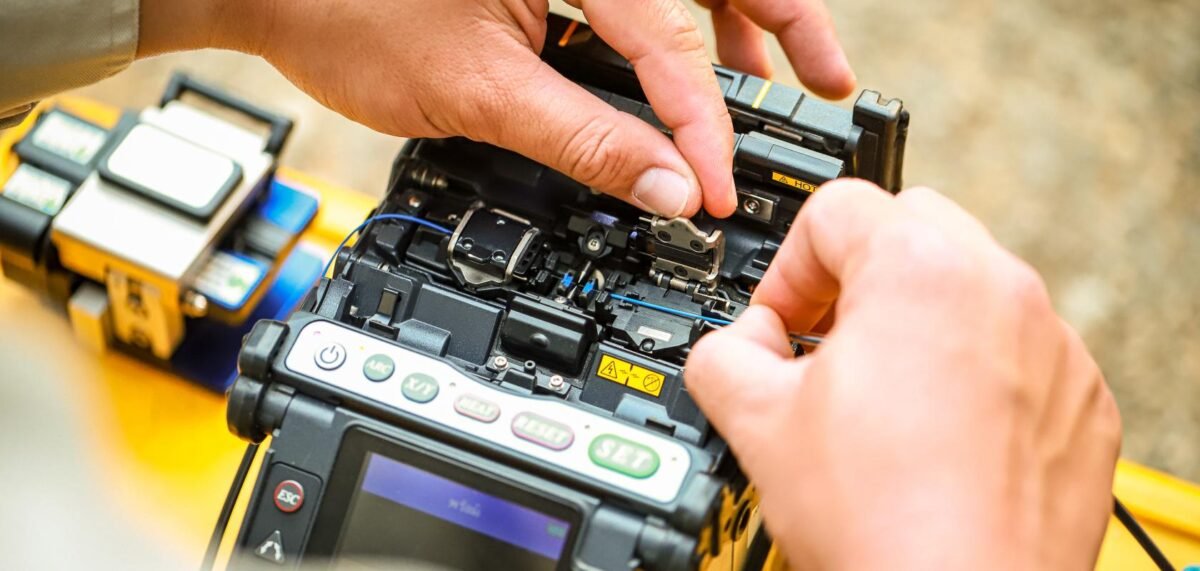
The fusion splicer is the most important tool in any FTTH deployment. It permanently joins optical fibers with minimal splice loss and creates reliable fiber connections.
A suitable FTTH fusion splicer should offer:
- Low splice loss
- Fast splicing speed
- Fast heating time
- Strong battery life
- Portable design
- Reliable alignment technology
Popular FTTH deployment models include:
Precision Fiber Cleaver
A fusion splicer cannot compensate for poor fiber preparation. Proper cleaving is essential for achieving low splice loss and reliable performance.
A professional cleaver provides:
- Accurate cleave angles
- Consistent results
- Reduced splice loss
- Improved productivity
The FC-6S High Precision Fiber Cleaver is a suitable option for FTTH installers and contractors.
Fiber Stripper
Fiber strippers remove the protective coating from optical fibers before cleaning and cleaving.
Quality stripping tools help:
- Prevent fiber damage
- Improve preparation quality
- Reduce installation errors
- Improve technician efficiency
Visual Fault Locator (VFL)
A Visual Fault Locator is one of the most useful troubleshooting tools for FTTH installations. It helps technicians identify:
- Fiber breaks
- Incorrect connections
- Bend losses
- Fiber continuity issues
Many modern fusion splicers include built-in VFL functionality, reducing the need for separate equipment.
Optical Power Meter (OPM)
An Optical Power Meter measures signal levels and verifies network performance.
Technicians use OPMs to:
- Verify signal strength
- Test optical links
- Troubleshoot attenuation issues
- Confirm successful installations
Integrated OPM functionality is available in several professional fusion splicer models.
Cleaning Equipment
Fiber cleanliness is critical to splice quality. Every FTTH toolkit should include:
- Isopropyl alcohol
- Lint-free wipes
- Cleaning sticks
- Dust-free storage containers
Proper cleaning reduces contamination and improves splice consistency.
Heat Shrink Sleeves
After fusion splicing, sleeves protect the splice joint from physical damage and environmental exposure.
Heat shrink sleeves:
- Protect fused fibers
- Improve durability
- Reduce mechanical stress
- Improve long-term reliability
Spare Electrodes
Contractors should always carry spare electrodes because worn electrodes can increase splice loss and create arc calibration issues.
For Signal Fire users, genuine Signal Fire Replacement Electrodes help maintain optimal arc performance.
Spare Battery
Battery failures or unexpected low battery levels can stop installations completely. Keeping a spare battery improves reliability and productivity.
A spare Signal Fire Replacement Battery is highly recommended for field technicians.
Power Adaptor and Charging Equipment
Reliable charging equipment ensures batteries remain operational throughout deployment projects.
A compatible Fusion Splicer Power Adaptor should always be included in the technician’s equipment kit.
Safety Equipment for FTTH Installations
| Safety Equipment | Purpose |
|---|---|
| Safety Glasses | Protect eyes from fiber fragments |
| Gloves | Improve handling safety |
| Warning Signs | Protect work areas |
| Waste Container | Collect fiber scraps safely |
Recommended FTTH Installation Kit
A complete FTTH installation kit should contain:
- Fusion splicer
- Fiber cleaver
- Fiber stripper
- Visual fault locator
- Optical power meter
- Cleaning supplies
- Heat shrink sleeves
- Spare electrodes
- Spare battery
- Power adaptor
- Safety equipment
This combination covers installation, testing, maintenance, and troubleshooting requirements.
Common Equipment Mistakes
Ignoring Backup Accessories
Many technicians carry the fusion splicer but forget critical accessories such as electrodes, batteries, and cleaning supplies.
Using Low-Quality Cleavers
Poor cleavers increase splice loss and reduce installation quality.
Skipping Testing Equipment
Without proper testing tools, technicians may struggle to identify faults and verify network performance.
Frequently Asked Questions
What is the most important FTTH installation tool?
The fusion splicer is the most important tool because it performs the actual fiber joining process.
Do I need both a VFL and an OPM?
Yes. A VFL helps identify faults, while an OPM measures signal levels and verifies network performance.
Why is a precision cleaver important?
The cleaver directly affects splice quality. Poor cleaving is one of the leading causes of high splice loss.
Should contractors carry spare batteries?
Yes. Spare batteries reduce downtime and improve productivity during large deployments.
Conclusion
A complete FTTH installation toolkit improves efficiency, reduces splice loss, simplifies troubleshooting, and helps technicians deliver higher-quality fiber optic installations. Proper planning ensures that installers have everything required to complete projects successfully.
In the next guide, we explore professional installation techniques in Fiber Splicing Best Practices for FTTH Technicians.
