
Networking
How Fiber Fusion Splicers Work
Jun
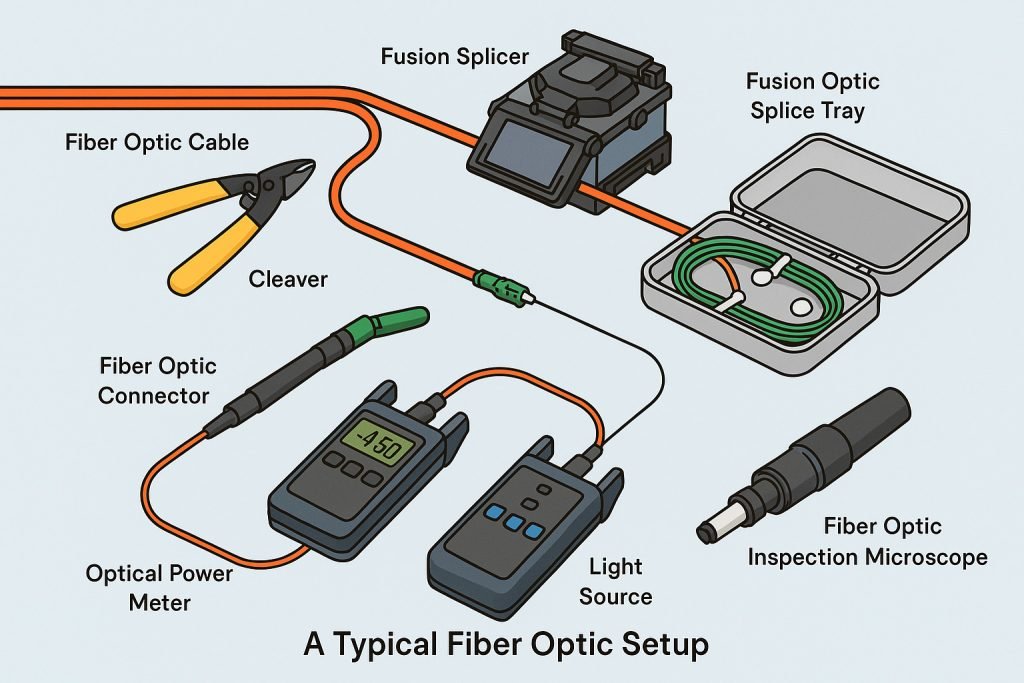
Fiber fusion splicers are among the most important tools used in modern fiber optic network deployment. They are responsible for permanently joining two optical fibers together by precisely aligning and fusing the glass fibers using controlled heat. Whether the project involves FTTH deployment, ISP infrastructure, enterprise networking, CCTV fiber systems, data centers, or telecom backbone networks, fusion splicers play a critical role in maintaining signal quality and network reliability.
While most technicians use fusion splicers daily, many people do not fully understand what happens inside the machine during the splicing process. Understanding how fusion splicers work helps installers improve splice quality, reduce errors, and make better equipment purchasing decisions.
This guide follows our previous article on Understanding Fiber Cleave Angles and Splice Quality. You can also browse our complete collection of Fiber Optic Splicing Machines.
What Is a Fiber Fusion Splicer?
A fiber fusion splicer is a specialized device that permanently joins two optical fibers by melting them together using an electric arc. The objective is to create a connection with minimal splice loss and maximum signal transmission efficiency.
Unlike mechanical splices that rely on alignment and connectors, fusion splicing physically joins the glass fibers into a single continuous optical path. This creates stronger, lower-loss, and more reliable fiber connections.
Why Fusion Splicing Is Preferred
Fusion splicing has become the preferred method of joining optical fibers because it provides:
- Lower splice loss
- Better long-term reliability
- Improved signal transmission
- Reduced maintenance requirements
- Higher network performance
- Stronger physical connections
For professional deployments including FTTH, ISP networks, and telecom infrastructure, fusion splicing is considered the industry standard.
The Fiber Fusion Splicing Process Explained
| Stage | Purpose | Importance |
|---|---|---|
| Fiber Preparation | Strip and clean fiber | Removes contaminants |
| Fiber Cleaving | Create flat fiber ends | Improves alignment |
| Fiber Placement | Position fibers in splicer | Prepares for fusion |
| Fiber Alignment | Align cores or cladding | Reduces splice loss |
| Arc Fusion | Melt fibers together | Creates permanent joint |
| Splice Verification | Estimate splice loss | Confirms quality |
| Heat Shrink Protection | Protect splice joint | Improves durability |
Step 1: Fiber Preparation
Before fusion can occur, the technician must prepare the optical fibers. This involves removing the protective coating, cleaning the fiber, and ensuring the glass surface is free from contamination.
Contaminants such as dust, moisture, oil, and debris can interfere with the fusion process and increase splice loss.
Typical preparation tools include:
- Fiber stripper
- Lint-free wipes
- Cleaning alcohol
- Fiber cleaning tools
Step 2: Fiber Cleaving
After cleaning, the fibers are cleaved using a precision fiber cleaver. The cleaver creates a flat end face that allows accurate alignment during splicing.
A poor cleave angle can increase splice loss and reduce splice quality.
Professional technicians often use tools such as the FC-6S High Precision Fiber Cleaver to achieve consistent cleaving performance.
Step 3: Fiber Placement
The prepared fibers are placed into the fusion splicer and secured using fiber holders and clamps. At this stage, the machine begins analyzing the fiber position.
Modern fusion splicers support various fiber types including:
- Single-mode fiber
- Multi-mode fiber
- Drop cable fiber
- Pigtail fiber
- Ribbon fiber
- Indoor and outdoor fiber cables
Step 4: Fiber Alignment
Fiber alignment is one of the most important stages in the fusion process. The machine positions the fiber ends precisely before fusion begins.
Fusion splicers typically use:
- Core alignment
- Cladding alignment
- Active cladding alignment
Core alignment systems generally provide higher precision and lower splice loss compared to basic cladding alignment systems.
For a deeper explanation, see our article on Core Alignment vs Cladding Alignment Fusion Splicers Explained.
Step 5: Arc Fusion
Once alignment is complete, the splicer generates an electric arc between its electrodes. The arc creates extremely high temperatures that melt the fiber ends together.
This process forms a continuous optical path with minimal signal loss.
The quality of the arc depends on:
- Electrode condition
- Arc calibration
- Environmental conditions
- Fiber preparation quality
How Electrodes Work
Electrodes generate the electric arc required for fusion. Over time, electrodes wear out and their performance begins to decline.
Common signs of worn electrodes include:
- High splice loss
- Arc calibration failures
- Inconsistent fusion results
- Frequent splice errors
Replacement components such as Signal Fire Replacement Electrodes help maintain reliable arc performance.
Step 6: Splice Loss Estimation
After fusion, the machine analyzes the completed splice and estimates splice loss.
This estimation helps technicians determine whether the splice is acceptable or requires rework.
Good fusion splices typically produce:
- Low attenuation
- Stable optical transmission
- Reliable long-term performance
Step 7: Heat Shrink Protection
After the splice is completed, a heat shrink sleeve is applied over the joint. The sleeve is heated inside the splicer’s heater to protect the fused connection.
The sleeve protects the splice from:
- Physical damage
- Moisture
- Dust
- Handling stress
Types of Fusion Splicers
| Type | Best For | Advantages |
|---|---|---|
| Core Alignment | Telecom, ISP, Backbone | Lowest splice loss |
| Cladding Alignment | FTTH and maintenance | Lower cost |
| Active Clad Alignment | Portable field work | Good balance of cost and performance |
Examples of Modern Fusion Splicers
Professional fusion splicers available today include:
These machines combine alignment technology, battery operation, integrated testing tools, and rugged field construction.
Common Fusion Splicing Challenges
Technicians often encounter challenges such as:
- Poor cleaving
- Dirty fibers
- Worn electrodes
- Arc calibration issues
- Battery limitations
- Environmental conditions
Understanding how the fusion process works helps technicians identify and correct these problems more effectively.
Frequently Asked Questions
How does a fusion splicer join fibers?
The fusion splicer uses an electric arc to melt and permanently join two optical fiber ends together.
Why is alignment important?
Proper alignment reduces splice loss and improves signal transmission quality.
Do all fusion splicers use electrodes?
Yes. Electrodes generate the arc required to melt the fiber ends during fusion.
What is the purpose of a heat shrink sleeve?
The heat shrink sleeve protects the completed splice from physical damage and environmental exposure.
Conclusion
Fiber fusion splicers work by preparing, aligning, fusing, testing, and protecting optical fibers to create low-loss permanent connections. Understanding the fusion process helps technicians improve splice quality, reduce troubleshooting time, and deliver more reliable fiber optic networks.
Next, we explore one of the most important maintenance topics for long-term splicer performance: When Should Fusion Splicer Electrodes Be Replaced?.
