
SSD vs HDD: Which Storage Drive Should You Buy in Kenya?
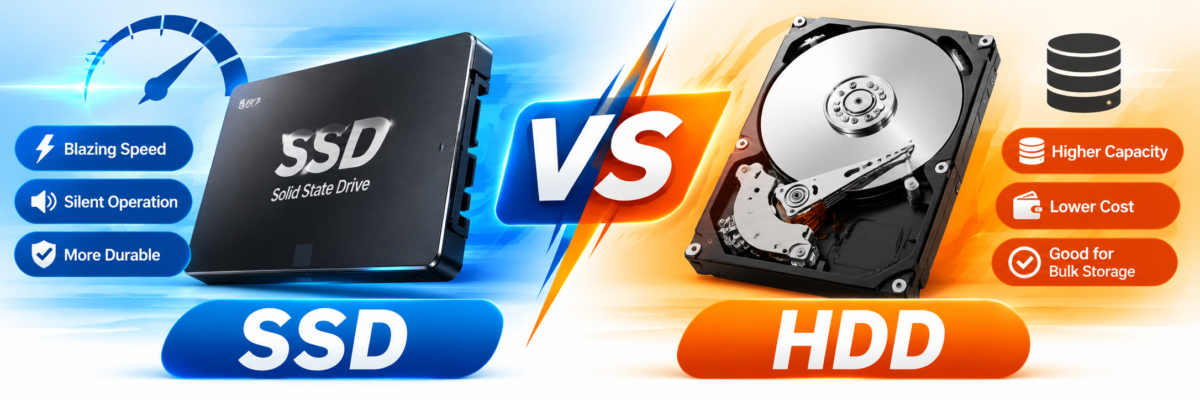
SSD vs HDD in Kenya is an important comparison when upgrading a laptop, expanding desktop storage, buying an external backup drive or selecting storage for business systems. A solid-state drive (SSD) generally provides faster data access and better resistance to mechanical shock, while a hard disk drive (HDD) typically offers more storage capacity for the money.
For everyday computing, gaming and demanding applications, an SSD is often the better choice. For large media libraries, file archives and suitable backup workloads, an HDD remains a practical option. Many users combine both technologies, installing an SSD for the operating system and applications while using a larger HDD for additional storage and backups.
SSD or HDD: Which Should You Choose?
Choose an SSD for faster startup, responsive applications, gaming and portable storage where speed matters.
Choose an HDD for high-capacity file storage, media archives and compatible backup or surveillance workloads.
Explore our storage accessories in Kenya or read our complete computer storage accessories buying guide for a broader overview of storage options.
SSD vs HDD: Head-to-Head Comparison
SSDs and HDDs both store digital information, but their underlying technologies affect performance, durability, power requirements and price. The table below summarizes the main differences.
| Feature | SSD (Solid-State Drive) | HDD (Hard Disk Drive) |
|---|---|---|
| Storage Technology | Flash memory without moving storage platters | Magnetic platters with moving read/write heads |
| Typical Sequential Speed | SATA: commonly around 500–560 MB/s; NVMe: varies widely, often several thousand MB/s | Common consumer models: roughly 80–250 MB/s, depending on the drive |
| System Responsiveness | Generally faster application loading and random data access | Generally slower random access and application loading |
| Shock Resistance | No moving storage mechanism | Mechanical components are vulnerable to physical shock |
| Noise | Silent storage operation | May produce spinning and seek noise |
| Power Consumption | Often efficient, but varies by model and workload | Power requirements vary by size, speed and workload |
| Cost per Gigabyte | Generally higher | Generally lower at higher capacities |
| Best Application | Operating systems, applications, gaming and active projects | Large archives, media libraries and suitable backup workloads |
Performance note: These are illustrative speed ranges, not guaranteed results. Actual transfer speeds depend on the model, interface, file sizes, system hardware and workload.
What Is an SSD and How Does It Work?
An SSD stores data using non-volatile flash memory. Unlike a traditional HDD, it does not rely on spinning platters or moving read/write heads to access information.
This design provides low-latency data access, which can make compatible computers feel considerably more responsive when starting Windows, opening applications and working with files.
Main Types of SSDs
2.5-Inch SATA SSD
Suitable for many compatible laptops and desktop computers with SATA connections. Often used to replace an older mechanical hard drive.
M.2 NVMe SSD
Uses PCIe connectivity to provide higher potential transfer speeds. Suitable for compatible modern laptops, desktops and gaming systems.
External SSD
Portable solid-state storage connected through a supported USB or other external interface. Useful for large file transfers and active projects.
Browse our internal SSD drives in Kenya for compatible laptop and desktop upgrades.
What Is an HDD and How Does It Work?
A hard disk drive stores information magnetically on rotating platters. A mechanical read/write assembly accesses the stored data, making HDDs different from flash-based SSDs.
HDDs remain widely used for large-capacity storage because they generally offer a lower cost per gigabyte, particularly at higher capacities.
Main Types of Hard Disk Drives
Internal Desktop HDD
Commonly uses a 3.5-inch form factor and SATA interface for compatible desktop computers and storage systems.
Portable External HDD
Provides convenient storage for backups, photographs, videos and other files through a supported USB connection.
Surveillance & NAS HDD
Specialized drives intended for compatible CCTV recording, network storage and other defined workloads.
Explore our external hard drives in Kenya for portable backup and high-capacity storage options.
SSD vs HDD Speed: Which Is Faster?
SSDs generally outperform HDDs in both sequential data transfers and random access. This difference is particularly noticeable when opening programs, loading operating systems and handling many small files.
SATA SSDs are limited by the SATA interface, while PCIe NVMe SSDs can deliver substantially higher transfer rates on compatible hardware.
| Storage Technology | Illustrative Sequential Transfer Speed | Typical Use |
|---|---|---|
| Consumer HDD | Approximately 80–250 MB/s | Large files, archives and backups |
| SATA III SSD | Commonly around 500–560 MB/s | General computer upgrades |
| PCIe Gen 3 NVMe SSD | Up to roughly 3,500 MB/s on many high-performance models | Modern laptops and desktops |
| PCIe Gen 4 NVMe SSD | Up to roughly 7,000–7,500 MB/s on many high-performance models | Gaming and demanding workloads |
These figures represent approximate sequential performance for selected drive classes. Entry-level models may be slower, and sustained write speeds can decrease during large transfers.
Does an SSD Make Windows Start Faster?
Replacing an older mechanical system drive with a compatible SSD can significantly improve startup and application-loading responsiveness. However, there is no universal boot-time guarantee because performance also depends on the processor, RAM, installed software and operating system configuration.
SSD vs HDD for Laptop Upgrades
For many laptops, an SSD is the preferred storage upgrade when slow startup, delayed application loading and general responsiveness are the main concerns.
Before purchasing, check whether your laptop supports a 2.5-inch SATA drive, an M.2 SATA SSD, an M.2 NVMe SSD or another storage arrangement.
Laptop SSD Compatibility Checklist
- Confirm the exact laptop manufacturer and model number.
- Check the supported storage interface and drive form factor.
- Verify the available M.2 slot and supported SSD protocol, where applicable.
- Confirm the required SSD capacity.
- Check whether the existing operating system needs cloning or reinstallation.
- Back up important files before replacing the current drive.
Important: Not all older laptops use 2.5-inch SATA drives, and not all newer laptops support NVMe upgrades. Some models have soldered storage or restricted upgrade options.
SSD vs HDD for Gaming PCs & PlayStation 5
Gaming computers can benefit from SSD storage through faster game loading, updates and file access. NVMe SSDs offer higher potential transfer performance on compatible motherboards.
For a PlayStation 5 internal storage expansion, Sony specifies compatible PCIe Gen4 x4 M.2 NVMe SSDs with suitable heat dissipation and physical dimensions. Sony recommends a sequential read speed of at least 5,500 MB/s.
Gaming PC
Choose an SSD compatible with the motherboard and intended workload. An NVMe drive may offer higher transfer speeds than SATA storage.
PlayStation 5
Check Sony’s supported M.2 NVMe specifications, dimensions and cooling requirements before purchasing an expansion drive.
Large Game Library
Consider sufficient SSD capacity for frequently played games and additional compatible storage for archived files.
SSD vs HDD for Video Editing & Photography
Photographers and video editors often handle large RAW image files, high-resolution video and project caches. SSDs are useful for active editing because of their fast access and transfer performance.
HDDs can complement this workflow by providing additional capacity for completed projects, original footage and secondary backups.
Recommended storage approach: Use a suitable SSD for active projects and applications, with separate backup storage for important source files and completed work. The required capacity and performance depend on the video format, bitrate and editing software.
For portable high-speed storage, compare our external SSD drives in Kenya.
SSD vs HDD for CCTV Surveillance Systems
CCTV systems may record continuously or according to configured schedules. Storage selection depends on the number of cameras, video resolution, bitrate, recording hours and retention requirements.
Surveillance-rated HDDs are commonly used in compatible DVR and NVR systems because they are designed for specified recording workloads and offer high capacities.
What to Check Before Buying CCTV Storage
- Recorder compatibility: Confirm supported drive interfaces and capacities.
- Camera count: More cameras generally increase storage requirements.
- Recording resolution: Higher-resolution video may require more capacity.
- Retention period: Calculate how many days of footage must be retained.
- Recording mode: Continuous and event-based recording have different storage demands.
- Drive workload: Select a model suitable for the intended recording environment.
Brands such as Western Digital offer surveillance-oriented storage products. Compare the exact drive model and manufacturer’s workload specifications before purchasing.
SSD vs HDD for Business & Office Storage
Businesses may need both fast workstation storage and high-capacity shared storage. SSDs are suitable for operating systems, frequently used applications and active files, while HDDs can provide economical capacity for appropriate archives and backup systems.
Office Workstations
SSDs support responsive operating systems, office applications and frequently accessed documents.
Shared File Storage
Suitable HDDs or SSDs may be used in compatible network storage systems according to capacity and workload needs.
Business Backups
External drives and NAS systems can form part of a structured backup plan with appropriate access controls and recovery procedures.
Explore our network-attached NAS storage in Kenya for compatible shared storage solutions.
SSD vs HDD Durability, Lifespan & Reliability
SSDs have no moving storage platters and generally tolerate physical movement better than HDDs. HDDs contain mechanical components that can be damaged by impacts, particularly during operation.
However, neither technology is immune to failure. SSD endurance depends on factors such as flash memory, controller design and write workload, while HDD reliability depends on mechanical condition, operating environment and workload.
| Reliability Factor | SSD | HDD |
|---|---|---|
| Moving Parts | None in the storage mechanism | Rotating platters and mechanical heads |
| Physical Shock | Generally more resistant | More vulnerable to mechanical damage |
| Wear Considerations | Flash write endurance and component condition | Mechanical wear and component condition |
| Data Protection | Requires separate backups | Requires separate backups |
Backup reminder: An SSD is not automatically more reliable than every HDD, and neither device should be the only copy of important data. Keep separate backups and periodically confirm that files can be restored.
SSD vs HDD Prices in Kenya
SSD and HDD prices in Kenya vary by manufacturer, capacity, interface, performance, endurance specifications and warranty terms.
SSDs generally cost more per gigabyte but offer faster access, while HDDs often provide better capacity value for large archives and backup requirements. Pricing differences can change with capacity and market availability.
Storage Options to Compare
256GB – 512GB SSD
Consider for compatible basic computer upgrades, operating systems and everyday applications.
1TB – 2TB SSD
Useful for larger application libraries, gaming, creative workloads and active project storage.
2TB – 4TB HDD
Consider for compatible high-capacity storage, media libraries and backup requirements.
For current prices, compare available products on Rapidtech Networks Limited’s category pages. Confirm the exact capacity, model number, interface and warranty before ordering.
SSD vs HDD: Which Storage Drive Fits Your Needs?
The best storage device depends on how frequently you access files, how much capacity you require and the performance supported by your equipment.
| Application | Suggested Storage | Reason |
|---|---|---|
| Student Laptop | Compatible SSD | Responsive applications and daily computing |
| Office Desktop | SSD for operating system and applications | Faster everyday file access |
| Gaming PC | Compatible NVMe SSD | High-performance game and application storage |
| Video Editing | SSD for active projects; separate backup storage | Fast workflow and additional archive capacity |
| Large Media Library | HDD | High capacity at a generally lower cost per gigabyte |
| CCTV Recorder | Compatible surveillance-grade HDD | Designed for suitable recording workloads |
| Business NAS | NAS-compatible HDD or SSD | Depends on capacity, workload and performance requirements |
SSD & HDD Brands Available in Kenya
Several established manufacturers offer storage products for laptops, desktops, gaming systems, external backups and business applications. Compare the exact model rather than relying only on the brand name.
Samsung
Offers internal and portable SSD products for compatible computers and demanding storage applications.
Western Digital
Offers SSDs, hard drives and specialized storage products for personal, NAS and surveillance requirements.
SanDisk
Provides portable solid-state storage and other removable storage solutions for compatible devices.
Lexar
Offers internal SSDs and portable storage products with different capacity and performance specifications.
Quick Buying Checklist Before Purchasing an SSD or HDD
Before placing an order, confirm that the selected storage device matches your computer, intended workload and required capacity.
- Confirm the computer or storage system model.
- Check SATA, M.2 NVMe, USB or other interface compatibility.
- Verify the drive form factor and physical dimensions.
- Select sufficient capacity for current and future files.
- Compare the drive’s actual read/write specifications.
- Review SSD endurance or HDD workload ratings where relevant.
- Check the manufacturer’s applicable warranty conditions.
- Plan data backup or migration before replacing an existing drive.
Related Storage Accessories Buying Guide
Complete Computer Storage Accessories Buying Guide in Kenya
Need to compare more than SSDs and HDDs? Our complete storage guide explains internal and external drives, USB flash drives, memory cards, NAS storage, interfaces, capacity selection and compatibility.
Frequently Asked Questions About SSD vs HDD
Is an SSD better than an HDD?
An SSD is generally better for fast data access and responsive computing. An HDD is often more economical for large-capacity file storage and suitable backup applications.
Which is faster, SSD or HDD?
SSDs generally provide faster sequential transfers and substantially lower access latency than mechanical HDDs. Performance varies by model and interface.
Should I buy an SSD for my old laptop?
A compatible SSD can significantly improve an older laptop’s responsiveness. Confirm the supported interface and form factor before purchasing.
Is a 512GB SSD enough for a laptop?
A 512GB SSD may be sufficient for general computing, documents and everyday applications. Large games, video projects and media libraries may require more capacity.
Is a 1TB SSD better than a 2TB HDD?
A 1TB SSD is generally preferable when speed matters, while a 2TB HDD provides more capacity for storing large files. The better option depends on your intended use.
Does an SSD improve gaming performance?
An SSD can improve game loading and asset access compared with an HDD. It does not automatically increase frame rates, which depend mainly on other system components and game requirements.
Can I use both an SSD and HDD in one computer?
Yes, if the computer supports both drives. Many systems use an SSD for the operating system and applications, with an HDD for additional files and storage.
Which drive is better for CCTV recording?
A compatible surveillance-grade HDD is commonly used for continuous DVR and NVR recording. Check the recorder specifications, camera count and required retention period.
Do SSDs last longer than HDDs?
Neither technology has a guaranteed longer lifespan in every situation. Reliability depends on the model, operating conditions, workload and other factors.
Are SSDs more expensive than HDDs in Kenya?
SSDs generally have a higher cost per gigabyte, while HDDs often offer better capacity value. Actual prices depend on the model, capacity and availability.
Where can I buy SSDs and HDDs in Nairobi?
Rapidtech Networks Limited supplies SSDs, hard drives and storage accessories online and from our Nairobi CBD office.
Do you deliver SSDs and hard drives outside Nairobi?
Yes. Rapidtech Networks Limited offers delivery arrangements across Kenya, subject to product availability, applicable charges and delivery conditions.
Buy SSDs & HDDs in Kenya from Rapidtech Networks Limited
Rapidtech Networks Limited supplies internal SSDs, external SSDs, hard disk drives and storage accessories for compatible laptops, desktops, gaming computers, office systems and business applications. Compare available capacities, interfaces, performance specifications and prices before purchasing.
We serve customers in Nairobi, Mombasa, Kisumu, Nakuru, Eldoret, Thika, Kiambu, Nyeri, Meru, Embu, Machakos, Kitale, Kericho, Kisii, Malindi and other towns throughout Kenya.
Our team can assist with SSD and HDD compatibility, storage capacity, interface requirements, drive selection and suitable storage options for personal or business use. Contact Rapidtech Networks Limited for product enquiries and quotations.
Browse our storage accessories in Kenya or call 0722 555 289 for assistance.
[…] For a broader storage comparison, read our SSD vs HDD buying guide in Kenya. […]